
How a Package of Protection Creates Layers Between Your Family and Financial Disaster

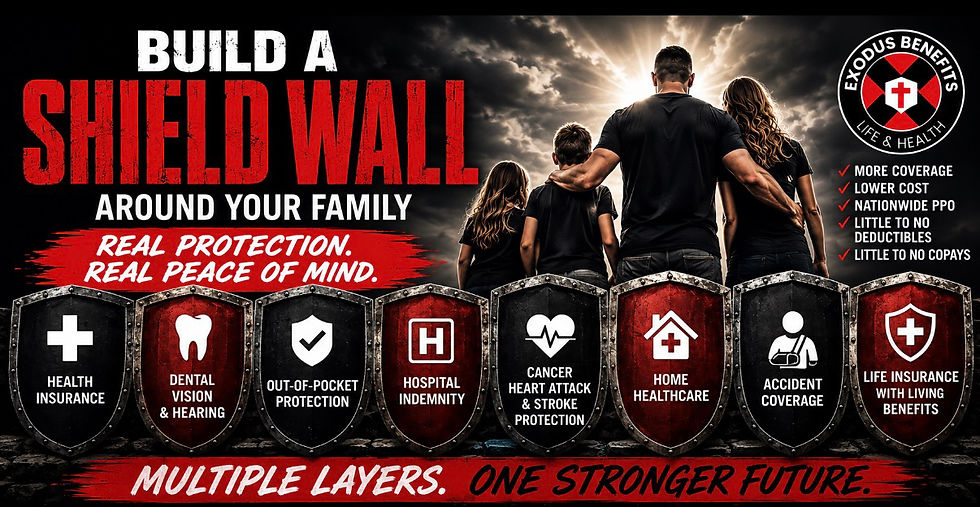
Build a Shield Wall Around Your Family
How a Package of Protection Creates Layers Between Your Family and Financial Disaster!
For centuries, warriors understood something simple: one shield could protect one person, but a wall of shields could protect everyone.
That same principle applies to protecting your family financially.
At Exodus Benefits, we don’t believe protection should begin and end with a single health insurance policy. Medical expenses don’t arrive neatly in one category. A serious illness can create hospital bills, deductibles, lost income, travel expenses, medications, rehabilitation costs, home-care needs—and financial pressure that can continue long after you leave the hospital.
That’s why we talk about building a Package of Protection.
Think of it as creating a shield wall around your family.
Each piece has a different job. One shield protects against major medical expenses. Another helps with the bills health insurance doesn’t pay. Another provides cash after an accident. Another steps forward after a cancer diagnosis, heart attack, or stroke. Another helps if you need care at home.
And behind all of them stands life insurance—not only to protect your family if you die, but, with certain policies, to potentially provide living benefits while you’re still alive.
The goal isn’t simply to own more insurance.
The goal is to eliminate as many financial gaps as possible.
SHIELD #1: Health Insurance — Your Foundation
Health insurance is the foundation of the wall.
Depending on eligibility, health, location, and available plans, some clients may have access to nationwide PPO options designed to provide flexibility when choosing doctors and hospitals.
For the right person, private health coverage may also offer combinations such as:
● Low or $0 deductibles
● Low or $0 copays for certain services
● Nationwide PPO network access
● Doctor and specialist benefits
● Prescription benefits
● Preventive-care benefits
● Hospital and surgical benefits
This can be especially attractive for healthy individuals, families, self-employed people, small-business owners, independent contractors, and others who may not be receiving a significant ACA subsidy.
But health insurance is only the first shield.
Because even good health coverage doesn’t necessarily protect your checking account from every expense created by a medical event.
SHIELD #2: Dental, Vision & Hearing
Medical insurance generally isn’t designed to handle your everyday dental, vision, and hearing needs.
That’s why we can add another layer.
Depending on the plan selected, Dental, Vision & Hearing coverage may help with expenses such as routine dental care, cleanings, X-rays, fillings, eye exams, glasses, contacts, hearing exams, and hearing-related expenses.
These aren’t necessarily catastrophic expenses—but they’re predictable expenses.
A good protection strategy isn’t only about surviving the worst day of your life. It’s also about managing the healthcare costs your family is likely to encounter year after year.
SHIELD #3: Out-of-Pocket Protection
This is where the shield-wall strategy starts becoming powerful.
Your primary health plan may pay according to its benefits, negotiated rates, network arrangements, or fee schedule—but you can still have expenses left behind.
An out-of-pocket protection plan can provide additional benefits when qualifying medical events occur.
Depending on the specific policy, benefits may be available for things such as:
● Hospital admission
● Outpatient surgery
● Diagnostic services
● Emergency treatment
● Other covered medical events
Instead of expecting one policy to do everything, we’re placing another shield behind the first one.
The health plan does its job.
Then the supplemental protection does its job.
SHIELD #4: Hospital Indemnity
A hospital stay can create expenses far beyond the hospital bill itself.
You could have transportation expenses, meals, childcare, time away from work, household expenses, or other costs that don’t disappear because someone is hospitalized.
Hospital indemnity insurance can provide fixed cash benefits for covered hospital events, according to the policy.
Depending on the plan, that may include benefits for hospital admission, confinement, ICU stays, outpatient procedures, or other covered services.
And because these benefits are separate from your primary medical coverage, they can create another financial layer around the family.
That’s the point of the shield wall:
One policy doesn’t have to carry the entire fight.
SHIELD #5: Cancer, Heart Attack & Stroke Protection
Now we’re protecting against some of the events that can completely change a family’s financial situation overnight.
A cancer diagnosis doesn’t just create medical bills.
Neither does a heart attack or stroke.
There can be travel, rehabilitation, missed work, childcare, household expenses, specialized treatment, and countless other costs.
Specified-disease or critical-illness coverage can provide benefits when a covered diagnosis or event occurs, subject to the policy’s definitions and limitations.
That money can help create something incredibly valuable during a medical crisis:
Options.
Instead of every decision being dictated by what’s left in the checking account, your family has another financial resource available.
SHIELD #6: Accident Protection
You don’t have to develop a major disease to end up with a large medical expense.
Sometimes life simply happens.
A fall.
A broken bone.
A sports injury.
A car accident.
A trip to the emergency room.
An ambulance ride.
Physical therapy.
Accident insurance can provide scheduled benefits for covered injuries and treatments.
That creates yet another shield.
Your medical plan can handle its portion of the expense while your accident coverage may provide additional benefits for the covered event.
Layers.
That’s the entire strategy.
SHIELD #7: Home Healthcare
This is one of the most overlooked pieces of protection.
People spend enormous amounts of time thinking about how they’ll pay for a hospital stay.
Far fewer ask:
What happens when I leave the hospital but still can’t take care of myself?
Recovery doesn’t always end when you’re discharged.
Depending on the coverage selected, home healthcare benefits may help provide resources for covered care received at home.
That can become extremely important after a serious illness, surgery, injury, or other qualifying event.
Because protecting your family isn’t only about getting you through the hospital doors.
It’s about helping you get home and recover.
SHIELD #8: Life Insurance With Living Benefits
Then we place one of the largest shields behind the entire wall.
Life insurance.
Traditionally, people think of life insurance as money that goes to your family after you die.
And that’s still incredibly important.
Life insurance can help protect a family against the loss of income and provide money for mortgages, debts, education, final expenses, and everyday living expenses.
But certain modern life insurance policies can potentially do more.
Policies offering living-benefit riders may allow an eligible insured to access a portion of the death benefit after qualifying events such as a terminal, chronic, or critical illness, depending on the policy and rider.
That means life insurance may have a role on both sides of the equation:
If you die, it protects the people you leave behind.
If you qualify for certain living benefits while you’re alive, it may help protect you and your family during the fight.
Why Bundle the Protection?
Here’s where people sometimes misunderstand what we’re doing.
We’re not stacking policies simply for the sake of having more policies.
We’re looking at the family’s total exposure.
Where can a major bill come from?
Where could income be interrupted?
What expenses might the primary health plan leave behind?
What happens after hospitalization?
What happens after an accident?
What happens after a cancer diagnosis?
What happens if someone needs care at home?
And ultimately:
What happens financially if Mom or Dad doesn’t come home?
Then we strategically position different products to address those risks.
One shield has gaps.
A shield wall creates layers.
And sometimes, depending on the client’s health, age, state, family size, eligibility, and available products, we’re able to build a comprehensive package with better overall protection at a surprisingly competitive monthly cost.
For some qualified clients, that can mean access to health options featuring little to no deductible, little to no copays for certain services, and nationwide PPO network access, while supplemental policies create additional protection around the medical plan.
Not every person will qualify for every product, and benefits, networks, exclusions, waiting periods, limitations, and underwriting vary by policy.
That’s exactly why the conversation matters.
Stop Shopping for One Policy. Start Building a Strategy.
The question shouldn’t simply be:
“How cheap can I get health insurance?”
The better question is:
“If something serious happens to my family tomorrow, where are the holes in our protection?”
That’s the conversation we want to have.
At Exodus Benefits, we look at the entire picture.
Health Insurance.
Dental, Vision & Hearing.
Out-of-Pocket Protection.
Hospital Indemnity.
Cancer, Heart Attack & Stroke Protection.
Accident Coverage.
Home Healthcare.
Life Insurance with Living Benefits.
Each one serves a different purpose.
Each one adds another layer.
Each one puts another shield into the wall.
Because insurance isn’t ultimately about policies.
It’s about protecting people.
Your spouse.
Your children.
Your income.
Your savings.
Your home.
Your future.
Your family.
Build the wall before the battle comes.
Exodus Benefits | Life & Health Insurance
Nationwide Coverage, availability, pricing, networks, underwriting requirements, exclusions, limitations, and benefits vary by product and state. Living benefits are subject to policy terms and qualifying events. This article is for general educational purposes and is not a guarantee of benefits, eligibility, savings, or coverage.


Comments